.png)
These Gorgeous Books Turned Into Our Entire Homeschool Enrichment Plan: The One-Book-Per-Subject Method

This post contains affiliate links. If you buy something through one of my links, I may earn a small commission at no extra cost to you. I only recommend books we own, have borrowed, or would happily put on our own shelf.
The moment I realized we needed more
My son hit early elementary age and something shifted almost overnight. Suddenly everything was a question. Why do volcanoes erupt? Where is Egypt? How does a rocket actually leave the ground? What's inside my arm?
He was hungry. Not for worksheets — for ideas.
And I stood there in the middle of my kitchen with my coffee going cold, realizing that our sweet, gentle, read-aloud rhythm wasn't quite enough anymore. He needed structure. He needed a plan. He needed someone to hand him the world in an organized way instead of in scattered, random pieces.
That someone was me. And I had no idea where to start.
Why I didn't buy a curriculum for enrichment subjects (even though I almost did)
Here's what nobody warns you about American homeschooling: the abundance is glorious and it is also paralyzing.
In Eastern Europe, where your education was handed to you in one neat stack of state-issued books. You didn't choose. You opened the book and you learned what was in it. There was something restful about that, even if there was nothing free about it.
Then I became a homeschool mom in the United States and discovered that I could choose anything. Co-ops. Subscription boxes. Library programs. Nature clubs. Twelve different science curricula, each one with a devoted following and a comment section full of mothers swearing it changed their lives.
I love this about America. I genuinely do. The freedom to build your child's education around his actual curiosity is a gift my own mother never had.
But I kept opening my cart and closing it again. Because a full curriculum meant:
A lot of money for one subject, for one year
A very deep dive into something my six-year-old might not even care about by November
A commitment to someone else's scope and sequence instead of my son's real interests
I didn't need a system. I needed a starting point — something that would tell me what comes next without telling me how far to go.
What I actually did instead

I stopped shopping for curriculum and started shopping for books.
Specifically, I picked one beautiful encyclopedia-style book per subject. One for science. One for geography. One for the human body. One for history, art, music, animals, space.
That's it. That's the whole method.
And I need to be clear about what kind of books these are, because this is the part people miss. These are not picture books anymore. They're also not textbooks. They live in that magical middle space — real information, properly explained, wrapped in gorgeous photography and illustration, written for a six, seven, or eight-year-old who is ready to be taken seriously.
This age group gets so badly overlooked. Everyone publishes for toddlers, and everyone publishes for middle schoolers. But the child who has outgrown Goodnight Moon and is nowhere near a biology textbook? That child needs these books. Desperately.
How one book runs our whole homeschool week
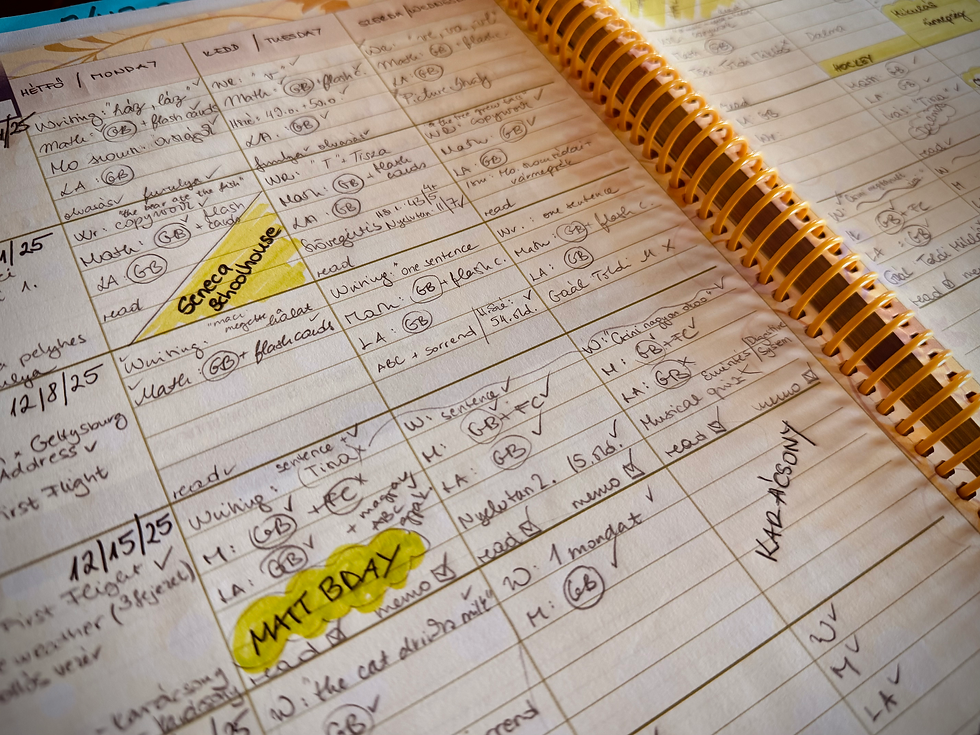
Let me show you what this looks like on a Monday morning, because the simplicity is the entire point.
Monday is science day. I don't plan anything the night before. I don't print anything. I pull down whichever science book we're using this month, I sit down next to him on the couch, and I open it.
Sometimes I open to where we left off. Sometimes I let him flip until something stops him. We read a spread together, or we just look at the pictures and talk about them.
And then — this is the good part — the book tells me what to do next.
If he's lit up, we follow it. We watch a video. We ask the internet. We look up whether there's a museum exhibit on it.
If it's a shrug, we close the book and we've still spent twenty lovely minutes together learning something true.
We live very close to Washington, DC, so I genuinely cannot complain about our options.
But that was actually part of my problem — too many options, no thread connecting them. The book became the thread. Now the Air and Space Museum isn't a random Saturday outing. It's the natural next step after the rocket page.
Last month it was exactly that. We read about how rockets work. He asked six questions I couldn't answer. We looked them up together. He did not want to build one, which I'll admit stung a little, but he did want to go see one. So we went.
That's the rhythm. Book → question → real world. Over and over.
The part that surprised me most
I thought I was buying information. I was actually buying a spine for everything else.
Once that book is open on the table, you can pull almost any subject into it:
Reading practice? Build a short paragraph about mushrooms, or butterflies, or the circulatory system. He's reading about something he already cares about, which is the only reason any child reads willingly.
Handwriting and copywork? One sentence from the page, in his own hand.
Art? Copy the structure of a medieval castle. Watercolor a cross-section of a leaf. Sketch the planets in order.
Narration? Close the book and let him tell it back to you. Charlotte Mason was right about this and she is still right.
Geography? We read about a country, then find it on our globe. (If you're globe shopping, I wrote a whole post on the best globes actually worth buying — the interactive ones have been a genuinely wonderful addition to our shelf.)
One book. Five subjects. No lesson plan.
Why this is the right season for it
There's a phrase from Charlotte Mason that I come back to constantly: give the child a feast of ideas. Not one dish, served endlessly. A feast. Variety, beauty, abundance — and then let him decide what he wants seconds of.
That's what this age is for. Six, seven, eight years old is not the season for specializing. It's the season for sampling. You are walking your child past every door in the house and letting him notice which ones he wants to open.
And when he does open one — when the interest starts growing hard and fast in a single direction — that's when I'll go research a real curriculum. That's when the money makes sense. Not before.
Until then, I'd rather have twelve beautiful books on a shelf than one expensive program in a box.
How to choose a book like this

If you're building your own shelf, here's what I look for:
Photography or illustration that stops you. If you don't want to look at it, he won't either. Beauty is not a luxury here — it's the hook.
Spreads that stand alone. You should be able to open to any page and have a complete, satisfying lesson.
Real vocabulary, gently explained. Say "photosynthesis." Then explain it. Children rise to the language you give them.
Enough depth to grow into. You want a book he can still get something from at nine that he loved at six.
Topics broad enough to branch. The best ones raise more questions than they answer. That's a feature.
Best books, by subject
Below is every book I'd recommend for building this kind of shelf, organized by subject. You do not need all of them — please don't try. Start with the two or three subjects your child is already circling. Add more when a new interest shows up.
Titles link through to Amazon so you can compare editions and prices.
🔬 Science

Book | Why I'd recommend it |
The workhorse of our shelf. Photography this good makes a seven-year-old sit still, and the topic range means you'll never run out of Mondays. | |
Usborne's genius is layering — a child can take the big picture at six and the fine print at ten. One purchase, many years. | |
The gentlest entry point here. Perfect if your child is just crossing over from picture books and needs a soft landing. | |
Built entirely from surprising facts and infographics. This is the one my son grabs on his own, which tells you everything. | |
Ideal if you have a younger sibling tagging along — big, bright, and genuinely readable to two children at once. |
🌎 Geography & Our World

Book | Why I'd recommend it |
Clear, uncluttered maps that a beginning reader can actually navigate. Pair it with a globe and you have a geography program. | |
Goes beyond where-things-are into why-things-are — climate, landforms, why people settled where they did. | |
If you can only buy one book in this entire post, I'd make it this one. It touches nearly every subject on this list. | |
Warmer and more illustrated than DK's version. Which you prefer really comes down to your child's eye. | |
Every country's profile is full of photos, and each nation has a full-color map detailing its main cities, landscape features, and borders, and exactly where in the world they are, in this engaging encyclopedia. | |
Updated yearly, packed with records, animals, and current facts. Ours has been read to pieces on car rides. |
🫀 Human Body

Book | Why I'd recommend it |
Answers the questions children actually ask — about bones, blood, and what happens to food — without ever getting clinical. | |
Friendly, uncrowded pages. A wonderful first body book for a sensitive child who might find realistic diagrams a bit much. | |
Written by a real pediatrician, with a genuinely warm voice. Slips in healthy habits without a whiff of lecturing. | |
Its body section is strong enough to carry you for months if you'd rather not buy a separate title yet. | |
The 3D CGI artwork in this one is spectacular. This is the book that turns a squeamish kid into a curious one. |
🏛️ History
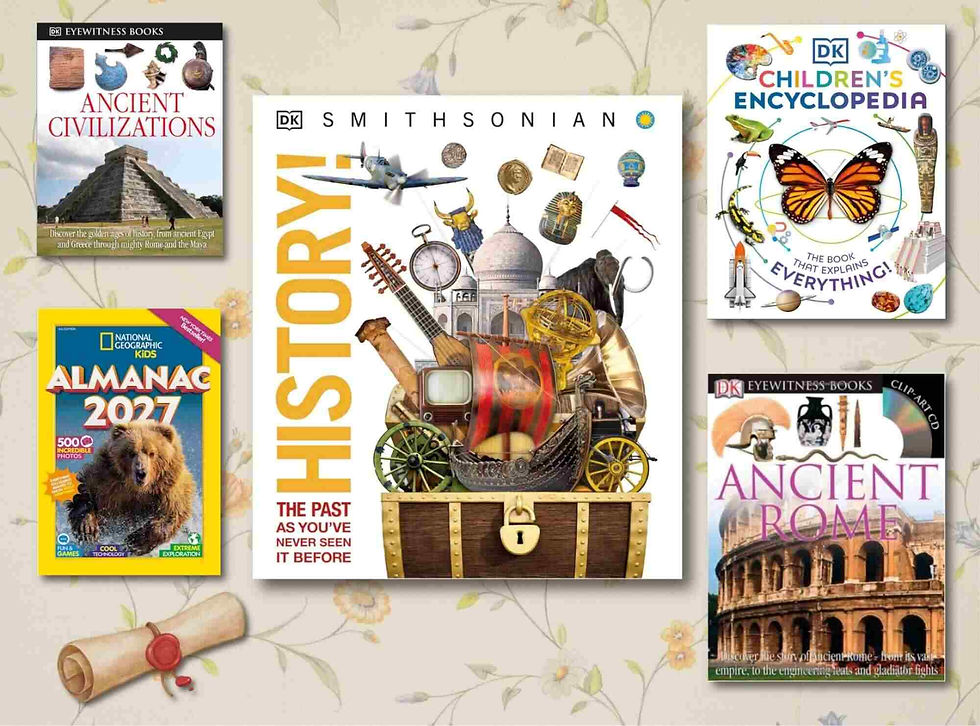
Book | Why I'd recommend it |
Gives you a walkable timeline of human history in one volume — enough to orient a young child before you go deeper anywhere. | |
Our history spine. Chronological, visual, and it keeps world civilizations side by side instead of in isolation. | |
Handy for connecting the past to right now — a surprisingly useful bridge when a child asks "but what happened after?" | |
Built around real artifacts and photographs, which makes the ancient world feel like something you could touch. | |
Pull this one out when Rome grabs him — and it will. Pairs beautifully with a museum visit or a Roman feast at your own table. |
🎨 Fine Arts & Art Appreciation

Book | Why I'd recommend it |
A proper little gallery between covers. Masterpieces reproduced large, with just enough context to spark conversation. | |
Phaidon treats children as real viewers. It asks questions about paintings rather than explaining them to death. | |
Its art pages make a lovely low-commitment introduction if you're not ready to invest in a dedicated art book. | |
The illustration style here is itself an education in how images can tell a story. | |
Organized by artist, with activities built in — the easiest way I've found to turn art appreciation into art making. |
🐘 Animals

Book | Why I'd recommend it |
Twenty-plus pounds of gorgeous wildlife photography, effectively. The definitive animal book for this age. | |
Organized by animal group, so a child absorbs classification without ever being taught it directly. | |
The classic Eyewitness treatment — specimen-style photography that makes a page feel like a museum case. | |
Short entries and big pictures. The right choice for a five- or six-year-old just starting out. | |
Steve Jenkins's cut-paper artwork is something else entirely. Worth owning as an art book, never mind the science. |
🌱 Plants, Fungi & Nature

Book | Why I'd recommend it |
Plant books are usually the dull ones. This isn't — the cross-sections and detail work are genuinely thrilling. | |
Covers the overlooked corners of the living world. Lichens! Nobody gives children lichens. | |
Its botany section is solid enough to serve as your nature spine before you commit to a dedicated title. | |
Good for placing plants inside the bigger story of life on earth, rather than treating them as a separate topic. |
🚀 Space

Book | Why I'd recommend it |
Real imagery from real missions. For a child in a rocket phase, this is the book to hand him. | |
Enormous, beautiful, and it takes scale seriously — the spreads on distance genuinely stop a child in his tracks. | |
A gentle way to cover planets and stars without buying a whole space book for a passing interest. | |
Its astronomy chapter connects space back to physics, which is where the really good questions start. | |
Strong on the how and why of space rather than just the what. Nice counterweight to photo-driven books. |
⚙️ How Things Work & Engineering

Book | Why I'd recommend it |
A modern classic, and deservedly so. Explains real machines through woolly mammoths, and somehow it works perfectly. | |
Each page of this mind-blowingly detailed and ambitious encyclopedia will guide you through the natural world and the technology that surrounds you. | |
The engineering facts scattered through this one spark more "wait, really?" moments than anything else we own. | |
Hands-on rather than reference — the natural companion volume when reading isn't enough anymore. |
🦖 Dinosaurs & Prehistoric Life

Book | Why I'd recommend it |
The most complete dinosaur reference written for children. Includes pronunciations, which will save your sanity. | |
Focused on fossils and how we actually know what we know. Quietly teaches the scientific method along the way. | |
Shorter and friendlier. A good first dinosaur book that won't overwhelm a newly independent reader. | |
The CGI reconstructions are extraordinary. This is the dinosaur book that gets requested at bedtime. |
🧠 Curiosity & "Why?"
Book | Why I'd recommend it |
Wonderfully browsable. Ideal for the child who reads in ten-minute bursts between everything else. |
If you only do one thing
Pick one subject your child has mentioned twice this month. Buy one book for it. Put it somewhere he'll see it.
Then next Monday, sit down and open it. Don't plan. Don't prepare. Just open it and see where he takes you.
That's how ours started, and it has turned into the most joyful part of our homeschool week.
Which subject is your child circling right now? Tell me in the comments — I love hearing what other families' children are obsessed with, and I'm always hunting for the next good book.

Comments