.png)
Why I Look Forward to Pumpkin Season Every Single Year (And How We Turn It Into a Full Homeschool Week)
Updated: Sep 3

There's a moment every fall when the pumpkins show up — on porches, at the grocery store, piled high at the local patch — and I feel this little spark of excitement I can't quite explain. Everything turns orange. The air changes. And suddenly I have the easiest, cheapest, most kid-approved homeschool theme just sitting there waiting to be used.
If you're a homeschool parent, you already know the value of a good "unit study" — a single, simple object that you can stretch across math, science, art, literacy, and more. Pumpkins might be the best one there is. They're inexpensive, they're everywhere this time of year, and kids of every age can touch them, measure them, paint them, carve them, and even learn to sell them.
Here's exactly how I plan a full Pumpkin Homeschool Week, subject by subject, plus the specific supplies that make each activity go smoothly (the product list is at the bottom, organized by category, so you can shop it in one place).
Math: Counting, Measuring, and Comparing
A trip to the pumpkin patch doubles as a math lesson before you even try. Younger kids can count pumpkins in a row or sort them by size. Older kids can measure circumference in inches or centimeters, weigh several pumpkins on a kitchen or produce scale, and keep a simple data chart of "tallest," "heaviest," and "roundest." I like having the kids predict first, then measure and see who was closest — it turns into a friendly little competition every year.
"Pumpkin Patch Count": count pumpkins in a row, then group by small/medium/large
Circumference race: each kid measures 3 pumpkins with a tape measure, records in inches and cm
Weigh-off: weigh pumpkins on a produce scale, rank lightest to heaviest
Predict-then-measure chart: guess "tallest," "heaviest," "roundest" before measuring, then check who was closest
Seed estimation jar: guess how many seeds are inside before cutting it open, then count them
Graph it: turn the week's measurements into a simple bar graph (weight vs. pumpkin)
Science: What's Actually Inside a Pumpkin
This is where pumpkin week gets really fun. Cut one open and let the kids explore the seeds and pulp under a magnifying glass or a basic kids' microscope. Try simple experiments: what happens when you heat pumpkin flesh versus freeze it? What happens if you dry and replant the seeds? These are easy, low-mess ways to introduce the scientific method — ask a question, make a prediction, test it, record what happened.
Dissection day: cut one open, sort seeds/pulp/flesh into separate bowls, examine under a magnifying glass or kids' microscope
Float or sink: test whether a whole pumpkin (and mini pumpkins) float in a tub of water, then guess why
Heat vs. freeze experiment: bake one chunk of pumpkin flesh and freeze another, compare texture/color after
Dry and replant: save seeds, dry them for a few days, then start some in a seed-starting kit to track germination
Decay observation journal: leave a carved pumpkin outside and take daily photos/notes on how it changes over 1–2 weeks
Nature Study: The Life Cycle of a Pumpkin

Pair the science exploration with a nature study on how pumpkins actually grow. When are they planted? Why do some vines produce giant pumpkins and others produce small ones? Why do textures and colors vary between varieties? A good pumpkin life-cycle book with real photos or diagrams makes this concrete for younger learners, and a nature journal lets older kids sketch and label what they're seeing.
Life cycle sequencing: use picture cards to put seed → sprout → vine → flower → pumpkin in order
Nature journal sketch: draw and label a pumpkin plant from a photo or a real vine if you have one
Variety comparison: lay out 3–4 pumpkin varieties (pie pumpkin, Cinderella, white, etc.) and compare shape/color/texture
"Why do vines vary?" discussion: read a life-cycle book, then have kids hypothesize why some pumpkins grow huge and others stay small
Business & Economics: Running a Pretend Pumpkin Patch

For older kids, this is my favorite extension. Talk through how an actual pumpkin patch makes money — why farmers often add petting zoos, corn mazes, or apple slingshots, and why many patches include a "free" pumpkin with admission. Have your child sketch out a business plan: What would it cost to plant, staff, and run a patch for a season? What would you charge for admission? A simple kids' economics or "start a business" book gives helpful vocabulary and a framework, even if you're doing all the numbers yourselves.
Business plan worksheet: kids sketch out what it would cost to plant, staff, and run a patch for a season
Set the price: have them decide admission cost and whether a "free" pumpkin is included, then explain why
Pretend pumpkin stand: set up a play cash register, price mini pumpkins, and "sell" them to siblings or parents
Add-on brainstorm: list extra attractions (corn maze, petting zoo, hayride) and estimate what each would cost to add
Profit math: given a cost-per-pumpkin and a selling price, calculate profit on a batch of 20
Literacy: Reading All Things Pumpkin
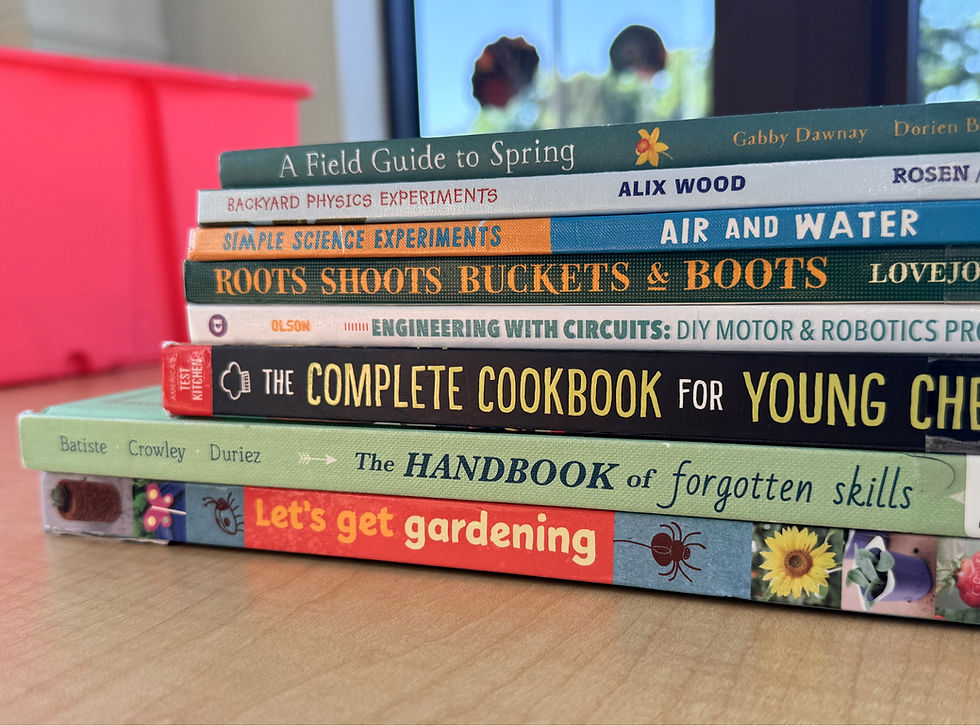
This one takes almost no prep — just gather a stack of pumpkin- and fall-themed books for read-aloud time. Picture books for littles, chapter books or nonfiction titles for older kids. I like rotating a couple of new titles into our shelf each year so it stays fresh.
Read-aloud stack: rotate 3–4 pumpkin/fall books through the week, one per day
Book bingo: littles check off books as they're read; older kids track titles in a reading log
Compare-and-contrast: after reading two pumpkin books, discuss how the stories differ
Nonfiction report: older kids pick one pumpkin fact book and write 3 things they learned
Art: Paint It, Decorate It, Carve It

You genuinely don't need many ideas here — pumpkins are basically a blank canvas. Paint them, glue on pom-poms and pipe cleaners, cover them in stickers, or go the classic route and carve them with a proper kid-safe carving kit. Try a new carving or decorating technique each year to keep it interesting.
No-carve pumpkin: decorate with pom-poms, pipe cleaners, and foam stickers for younger kids
Painted pumpkin scenes: paint a face, animal, or fall scene using acrylic paint
Stencil carving: use a stencil pattern book to carve a design, lit with an LED tea light
"New technique" challenge: each year try a different method — marbling, glitter, mod podge decoupage
Creative Writing: Give the Pumpkin a Voice
Wrap up the week with writing. Have your kids write a poem or ode to a pumpkin, a silly love letter, or a bedtime story where the pumpkin is the main character. A dedicated writing journal with prompts already built in takes the pressure off "what do I write about" and just gets pencils moving.
Ode to a pumpkin: write a short poem about a pumpkin using a poetry workbook for structure
Pumpkin love letter: write a silly, over-the-top love letter to a pumpkin
Bedtime story: write a short story where the pumpkin is the main character, then "publish" it in a blank storybook kit
Mail it: address and mail the pumpkin love letter using real envelopes and stationery
---
Pumpkin Homeschool Week: Shop the Supplies by Category
🎃 Carving & Decorating (Art)
Product | Why I like it |
Safe, dull-edged tools designed for small hands | |
No flame, safe to leave lit unattended | |
Great for kids who want a guide before freehanding | |
For no-carve, no-mess painted pumpkins | |
Cheap, versatile pumpkin "hair" and legs | |
Easy texture and 3D decorating | |
No-carve decorating for toddlers and preschoolers | |
All-in-one kit if you want zero prep |
📐 Math & Measuring
Product | Why I like it |
Weigh pumpkins in pounds or grams | |
Best for measuring round pumpkin circumference | |
Track measurements across multiple pumpkins | |
For inch/centimeter measuring practice | |
Turn measurement data into simple bar graphs | |
Ready-made worksheets if you want less prep |
🔬 Science & STEM
Product | Why I like it |
Examine pumpkin seeds and pulp up close | |
Cheaper alternative for younger scientists | |
Record predictions and observations | |
Replant and sprout saved pumpkin seeds | |
Track temperature changes when heating/cooling pumpkin flesh | |
Structured pumpkin "dissection" activity | |
Makes any experiment feel official |
🌱 Nature Study & Life Cycle
Product | Why I like it |
Classic, simple life-cycle explanation for young kids | |
For sketching and labeling pumpkin plants | |
For detailed nature journal drawings | |
Hands-on ordering activity for visual learners | |
If you're planting your own seeds at home | |
Compare colors, shapes, and textures by variety | |
Track sun, rain, and temperature if growing pumpkins |
💰 Business & Entrepreneurship (Older Kids)
Product | Why I like it |
Introduces basic business vocabulary | |
Covers cost, profit, and pricing basics | |
Hands-on practice "running" a pumpkin stand | |
Sketch out the pretend pumpkin patch layout | |
For estimating costs and profit margins | |
Simplifies supply, demand, and pricing concepts | |
Guided template so they're not starting from a blank page |
📚 Literacy & Read-Alouds
Product | Why I like it |
Sweet, simple read-aloud for younger kids | |
In this cheerfully-illustrated book, children can learn about the growth cycle and many varieties of pumpkins, and even how to plant their own. | |
Ties in nicely with the science/decay observations | |
Combines literacy with a counting/math tie-in | |
For kids just starting to read independently | |
Pairs read-alouds with simple comprehension questions | |
Track the books they finish during pumpkin week |
✏️ Creative Writing & Journaling
Product | Why I like it |
Built-in prompts for poems, letters, and stories | |
Seasonal cover and prompts to match the theme | |
For turning their pumpkin story into a real "published" book | |
Makes journaling more fun for reluctant writers | |
Structure for the "ode to a pumpkin" activity | |
For younger kids still working on letter formation | |
For "writing a love letter to a pumpkin" as an actual mailable letter | |
Small incentive for completing each writing task |
---

I love how pumpkin season turns simple autumn moments into fun learning experiences. It also creates the perfect opportunity to explore creative seasonal styles. Families can make the experience even more exciting by discussing Halloween Fashion 2026 and discovering how costumes, colors, and cozy outfits bring the spooky season to life.
Pumpkin season brings back such tender childhood memories, especially the little moments that make family traditions feel unforgettable. I can already imagine the joy behind these jack o lantern outfits ideas, turning simple pumpkin activities into memories children will carry for years.